
Resin and Consumables
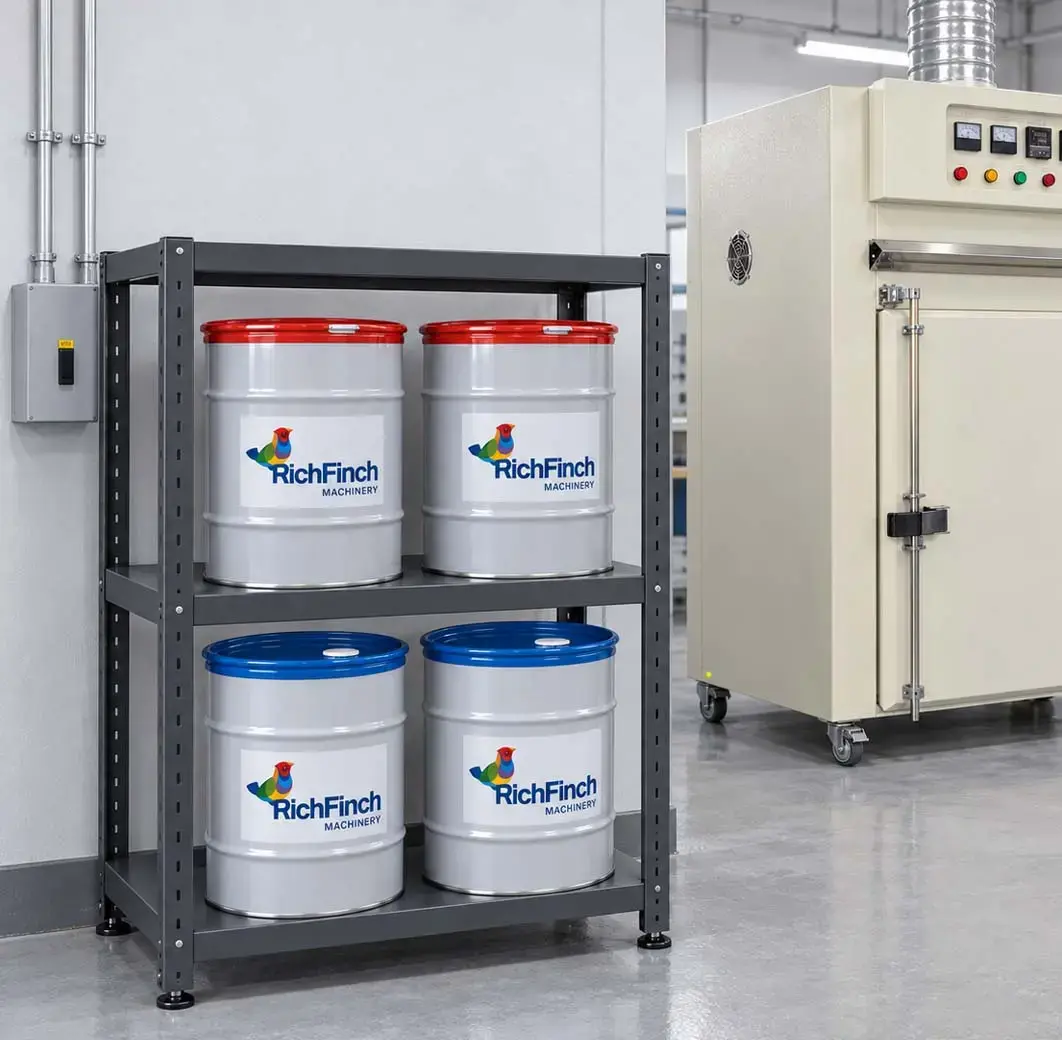
A doming machine is only as good as the material it runs on. The Finch500 runs on a European two-component polyurethane resin supplied by us, with dispensing profiles in the software matched to it – so the machine you buy and the material it produces with are one system, not two purchasing problems.
What the Cured Resin Does
The properties that decide whether a domed sticker survives its first year outdoors.
The cured polyurethane layer resists yellowing, clouding and discoloration under prolonged sun and weather exposure, and stands up to water, sea water, motor oil, industrial chemicals and scratches. It bonds securely to printed sticker and label surfaces, with no separate primer step, and holds up through repeated humidity and temperature cycling in accelerated ageing testing, without loss of mechanical or visual properties. The coating holds from −30 °C to +60 °C. It is designed for long-term outdoor use and tested for extended UV and weathering exposure.
It is optically clear and self-levelling: the dome forms itself, holds its shape at the edge of the die-cut without flowing over it, and stays flexible enough to follow a curved surface.
Regulatory Declarations
What the material’s data sheet formally declares – the questions a buyer’s compliance officer asks first.
- REACH
- every component in the formulation is registered under Regulation 1907/2006. The formulation contains no substances from the SVHC candidate list, none from the Annex XIV authorisation list and none from the Annex XVII restriction list.
- RoHS
- mercury content in the cured polymer is at or below the limit set by Directive 2011/65/UE, and the formulation contains no components restricted under Annex II as amended by Directive 2015/863/UE (RoHS III).
- EN 71-3 (toy safety)
- the cured polymer meets the requirements of EN 71-3:2019, the migration-of-elements standard. This is what makes domed stickers usable on products for children.
- Phthalates
- meets Directive 2005/84/EC on phthalates in toys and childcare articles.
- PFAS
- perfluoroalkyl and polyfluoroalkyl substances are not intentionally included in the formulation.
- Biocides, DMF, POPs
- none from Regulation 528/2012, Directive 2009/251/EC or Directive 2012/519/EU.
- Benzotriazoles and Bisphenol-A
- not part of the formulation.
- Automotive (GADSL, ELV, IMDS)
- components are not on the GADSL list, are not restricted under Directive 2000/53/EC, and the resins can be registered in the IMDS database.
- United States (TSCA, conflict minerals)
- all ingredients are listed on the EPA’s TSCA 8(b) inventory, and no conflict minerals as defined by the SEC are used in production.
Declarations are those of the resin manufacturer’s technical data sheet, current as of its January 2025 revision. Full documentation is provided with your first supply.
The Supply Program
Resin is quoted separately from the machine and supplied on an ongoing basis.
Resin is supplied in production batches with a minimum order of 240 kg – enough material for roughly 150–192 m² of doming coverage, depending on sticker size and the resin consumption settings in the software. It is a production quantity, not a sample: the first order is meant to carry real orders, not a test sheet.
Supply is ongoing, not one-off. Your production keeps running on material with known behaviour and known dispensing profiles, instead of a new product that has to be tested – and re-tested – every time a batch changes.
How Many Stickers From One Order?
Enter your sticker size to see roughly how far a 240 kg order goes.
Fill in your sticker size to see the estimate.
What Else the Machine Consumes
Short answer: less than most people expect.
No disposable mixing tips
The mixing section washes itself on the machine – about two minutes at the end of a run, without dismantling anything. Machines that use disposable static mixers consume one per run, and that cost never appears in their price.
Cleaning liquid
Used by the built-in wash cycle. Ordered through the same channel as resin.
Wear parts
Seals and other moving-part consumables wear out on any dispensing equipment eventually. A starter set ships with the machine, and replacements come through the same single point of contact – so a worn seal is a scheduled replacement, not a stopped production line waiting on an unknown supplier.
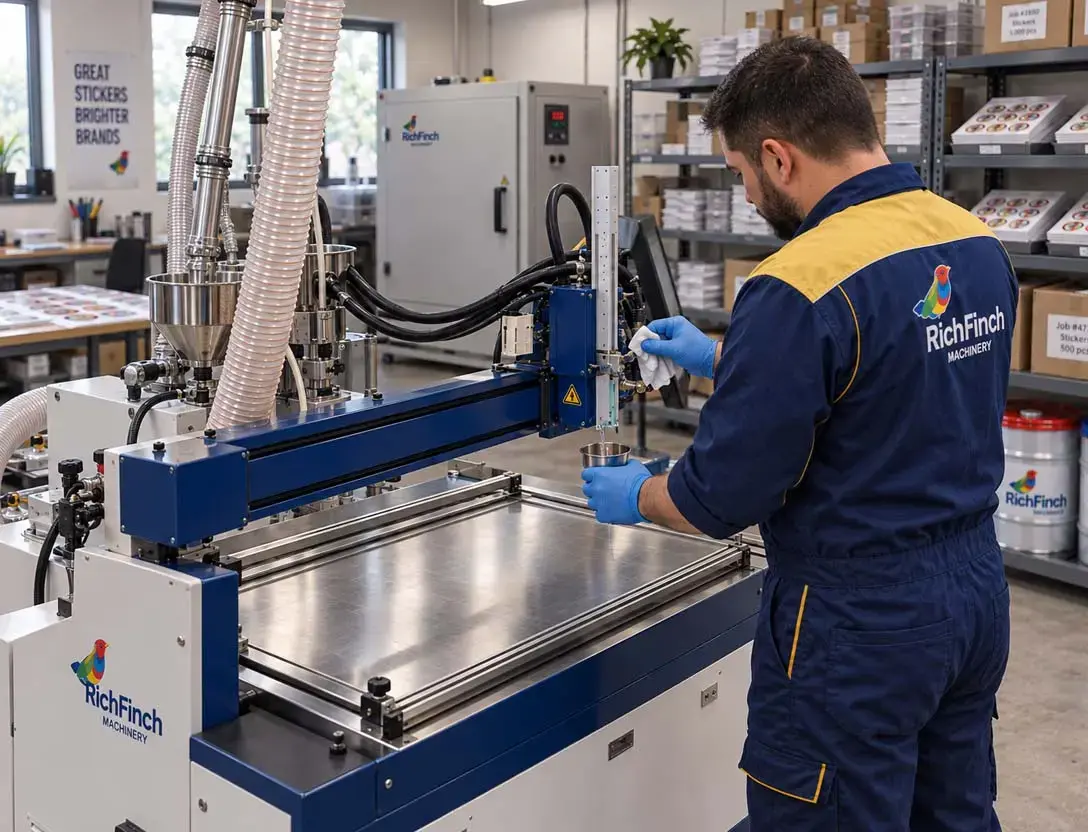
This is the question that decides what a cheap machine really costs: not the price on the invoice, but who supplies the material and the parts twelve months later, and how long the line stands still while you find out.
Storage and Shelf Life
What to plan for when you order a batch.
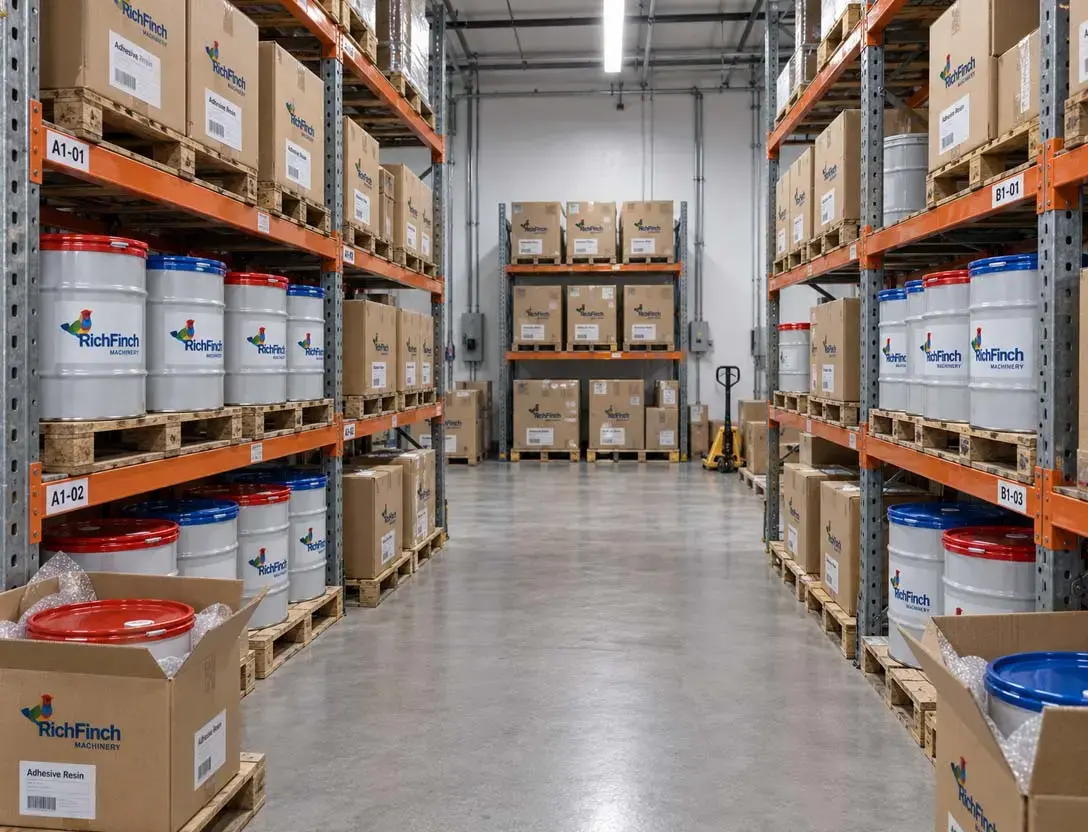
Both components keep for 12 months in the original unopened packaging, stored at room temperature from 5 °C to 25 °C. That is the planning horizon for a production batch: enough to hold stock against a busy season, not so long that ordering a year ahead makes sense.
Order Resin or Ask About Supply
Tell us what you produce and in what volumes – we’ll come back with supply terms for your country.