
Finch500 Automatic Doming Machine
Automatic polyurethane doming system for sheet-based production – 3D stickers, sticker packs and domed labels, with software, resin supply and operator training included.
The Finch500 is built for one job: applying polyurethane resin to printed, contour-cut sheets with a repeatable dome. It is not a general-purpose dispensing platform adapted to stickers – the software, the dispensing control and the resin are matched to sheet-based doming production.
Printed sheets go straight from your cutting plotter into the machine. There is no drying or degassing wait after printing, and no manual resin application at any point in the process.
Worldwide shipping · 1-year warranty · Operator training included
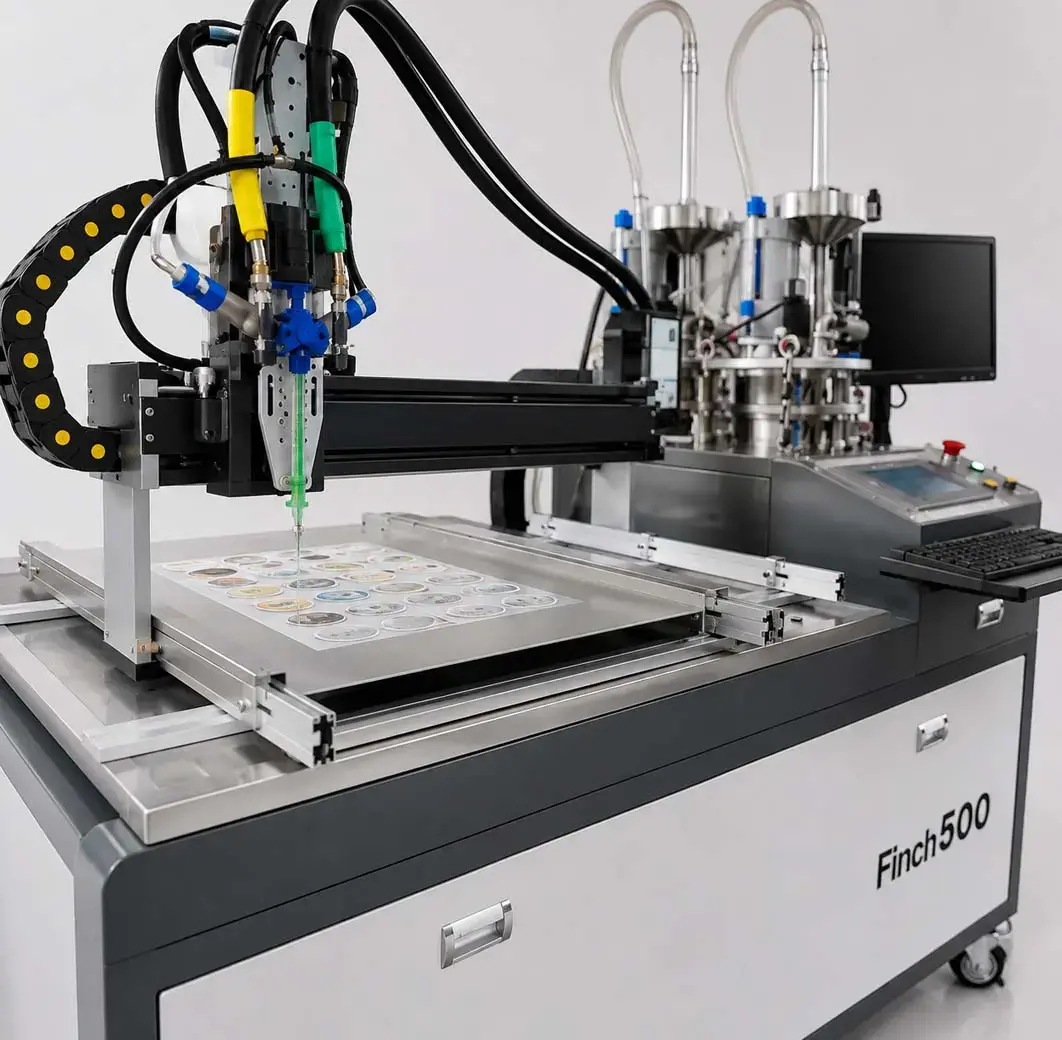
Finch500 Technical Specifications
Configuration is confirmed at quotation, based on your production format and destination.
| Machine type | Automatic two-component doming machine, sheet-based |
|---|---|
| Resin | Two-component polyurethane |
| Control | PC-controlled, Finch500 layout software |
| Operation | Automatic – feeding, metering, mixing and dispensing |
| Max sheet format | 700 × 700 mm |
| Traverse speed | 300 mm/s |
| Dispensing rate | 1–12 ml/s |
| Repeat positioning accuracy | ≤0.2 mm |
| Dispensing accuracy | ±2% |
| Metering accuracy | ±2% |
| Resin feed | Two-cylinder plunger pumps |
| Resin tanks | 2 × 25 L stainless steel, heated, with stirrers |
| Monitoring | Pipeline pressure and resin level, real time |
| Curing | Heated curing oven, included |
| Curing trays | 60, one sheet per tray, 340 × 680 mm |
| Machine dimensions | 1,500 × 1,200 × 1,600 mm (machine only, excl. curing oven) |
| Weight | 512 kg |
| Power supply | 220V / 50Hz / 1500W (machine only) |
| Warranty | 1 year |
Full specifications for your configuration are provided with your quote. The 700 × 700 mm working field applies to both the gantry and the dispensing head – resin can be placed at any point across it, not only on a fixed grid.
How the Dispensing System Works
Two-component resin, metered and mixed inside the machine – not prepared by hand at the bench.
Automatic from tank to sheet
Feeding, metering, mixing and dispensing run as one automatic cycle. The operator loads sheets and starts the job.
Metered, not mixed by eye
Plunger pumps hold the component ratio to ±2% – the same accuracy whether a shape takes a full dose or a few drops for a small detail. Manual mixing is where dome quality starts to drift: cure times change and domes stay tacky or cloudy.
Degassed in the tank, purged at the pour
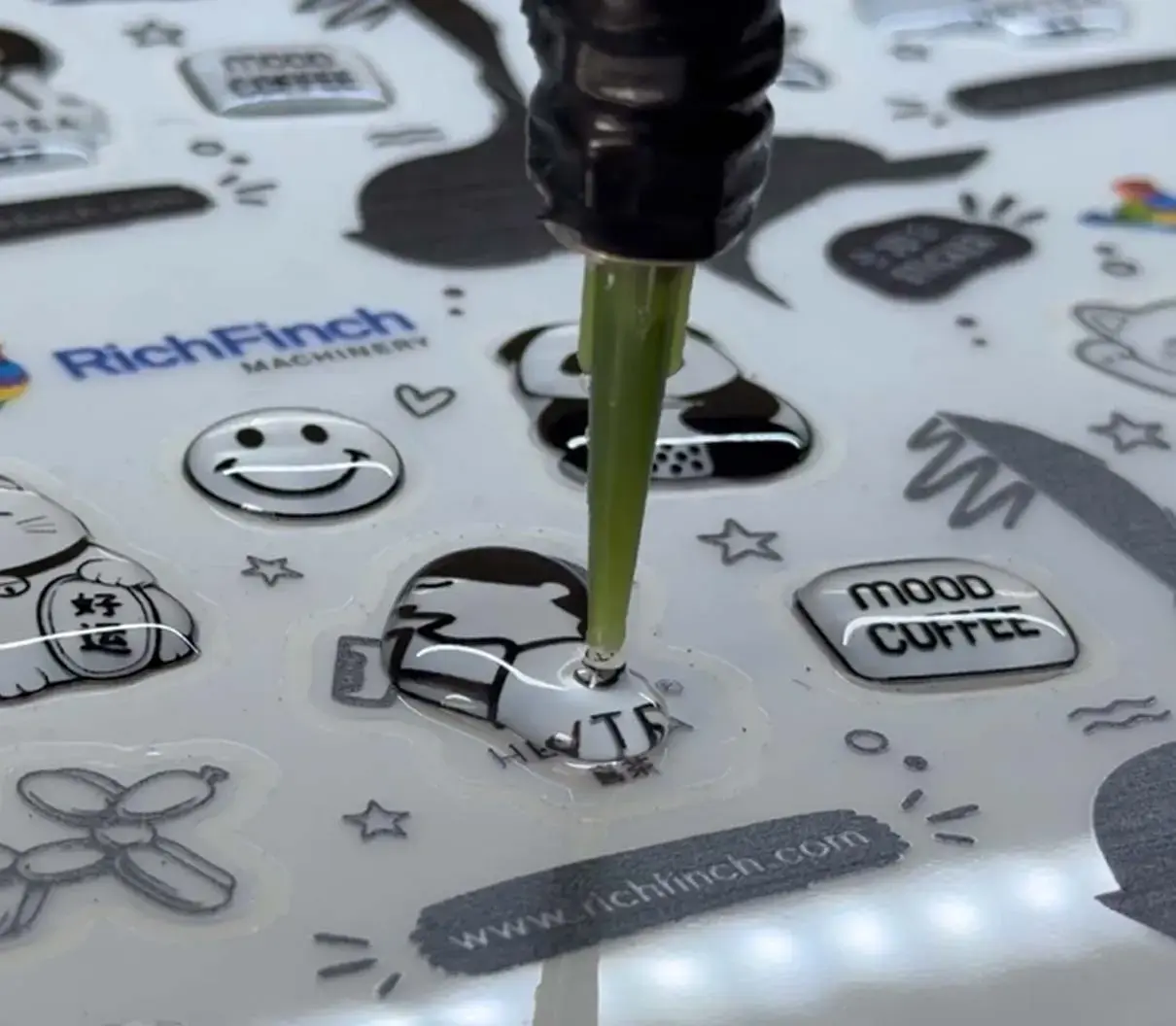
Each tank is vacuum-degassed on its own, once, right after it's refilled with resin components – there is no air left in the system once a job starts. At the start of every run, 60–80 g of resin is purged through the mixer to clear any bubbles it picked up; dispensing runs bubble-free from that point on. Domes cure clear, without the pinholes and bubbles that show up when resin is mixed and applied by hand.
Heated tanks, stable resin
Resin temperature is held steady through heated tanks, lines and pumps, with stirrers in the tanks, so viscosity stays consistent through a production run – the same dose behaves the same way on the first sheet and the last.
Clean output
Controlled dispensing without dripping between shapes. On a doming sheet a stray drop is a rejected sticker, not a cosmetic issue.
Monitored while it runs
Pipeline pressure and resin level are tracked in real time. Level sensors call for a refill before a tank runs low, and a job stops on a fault instead of finishing as a ruined sheet.
Adjustable down to micro-doming
The same precision holds at the small end too: turning down the dispensing rate – adjustable across 0.5–7 g/s – lets the machine lay down micro-doming shots: small, precise volumes that are next to impossible to hold steady by hand or on a simpler machine. The machine and resin handle micro-stickers whenever a job calls for them; the head isn't limited to a fixed layout either, and can dispense at any point across the full 700 × 700 mm working field.
How Finch500 Differs from General-Purpose Dispensing Machines
Dispensing machines are built to dose adhesive onto parts. Doming stickers is a different production task – and the difference shows up in setup time, not in the datasheet.
- Built for sheets, not for parts
- Finch500 works with printed self-adhesive sheets – the same sheets your printer and cutting plotter already produce. General-purpose machines are built around fixtures and single parts, which means every new job starts with mechanical setup.
- Layouts, not coordinates
- Finch500 software reads the cut layout, identifies every shape and generates the dispensing paths. On a general-purpose machine, positions and volumes are usually taught manually – the more shapes on the sheet, the longer that takes.
- Resin is part of the system, not a separate project
- Dispensing parameters are matched to a polyurethane resin tested for this process. With a generic machine, resin selection, dose calibration and dome behaviour become your development work.
- Curing is part of the package
- Doming needs controlled curing, not just dispensing. The Finch500 package includes a heated curing oven and 60 trays – a dispensing machine on its own leaves that half of the process to you.
- No wait between printing and dispensing
- Printed and cut sheets go directly into the machine. No drying stage, no degassing wait – production runs at the pace of your printer.
Finch500 Software
The part of the system that decides how long a new job takes.
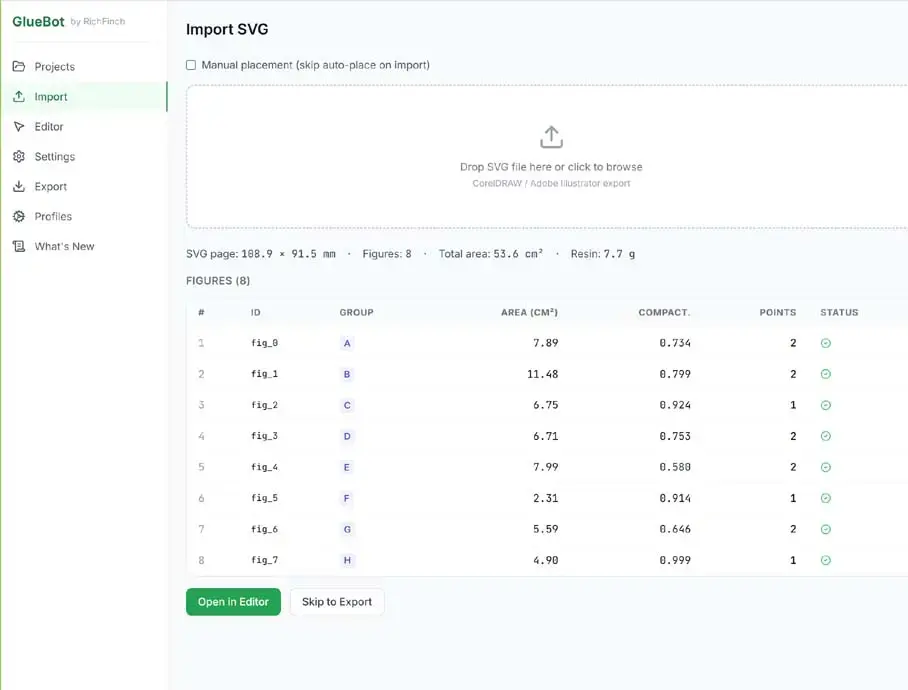
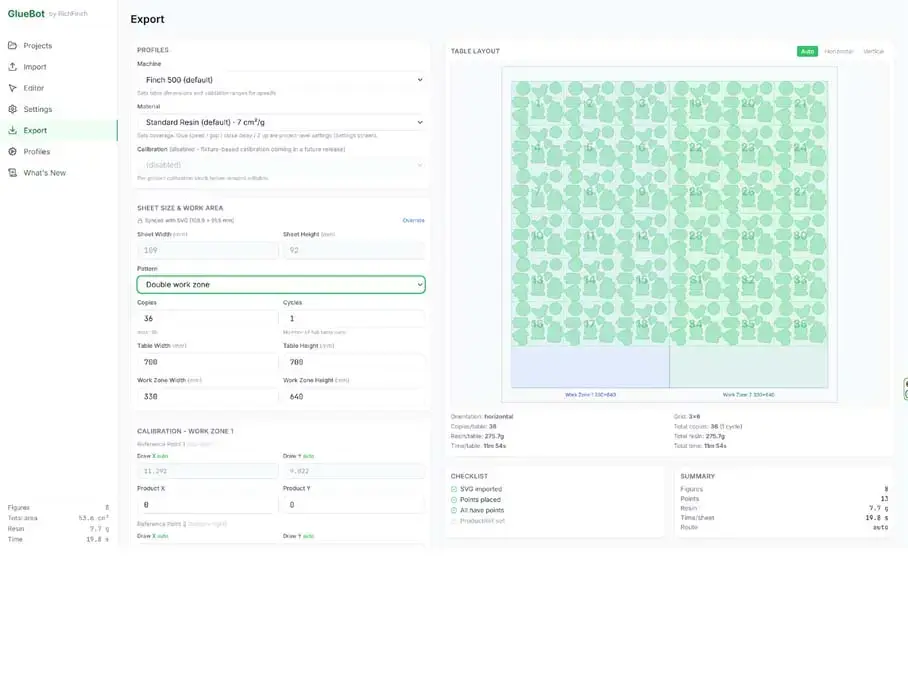
The machine is PC-controlled: instead of teaching dispensing points on a panel, you load the layout you already produced for cutting.
- Imports your cut layout file
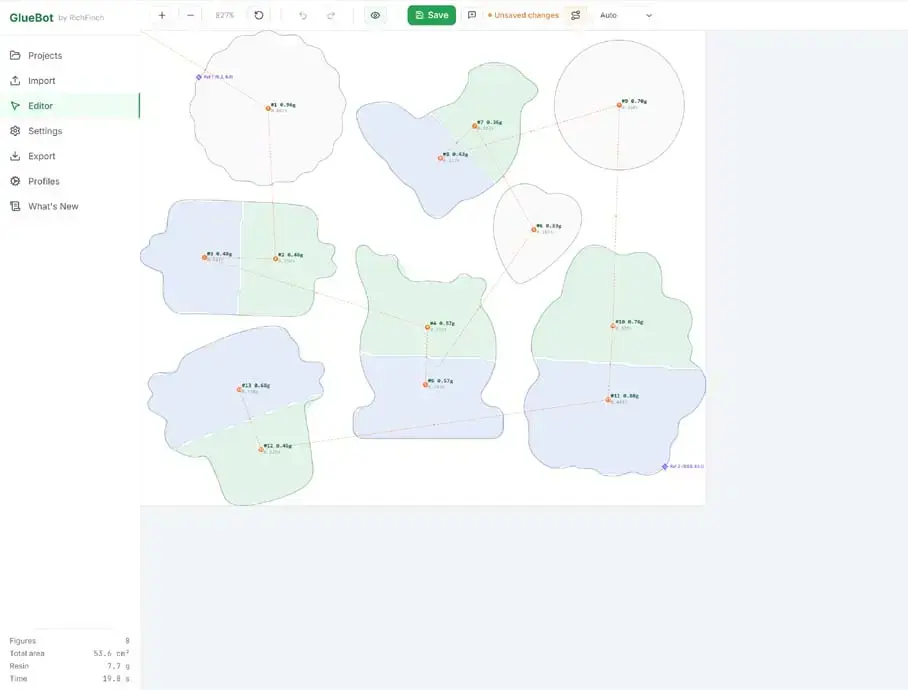
- Recognises every shape on the sheet, including mixed shapes and sizes in one job
- Places dispensing points and calculates the required resin volume automatically
- Generates the dispensing paths
- Flags the layout for the operator to check before it runs – nothing dispenses until it’s confirmed
- Saves the job, so a repeat order starts with opening a file and loading the sheet – no setup at all
On a general-purpose dispensing machine, teaching every point by hand typically takes 90–120 minutes per new layout. In the Finch500 software the same new layout is ready in 1–3 minutes – and a repeat order is faster still: open the saved job, load the sheet, start dispensing.
Setting up a new layout by hand costs more than time – resin goes into test pours and adjustments while the job is dialed in. The software removes that trial and error, so a new layout can run on up to 10x less resin than manual setup for the same job.
Short runs and custom die-cut shapes stop being a problem – the software adapts to a new layout, so a 50-piece order is prepared the same way as a full production sheet.
Polyurethane Resin and Supply
The machine and the resin are quoted and supported together.
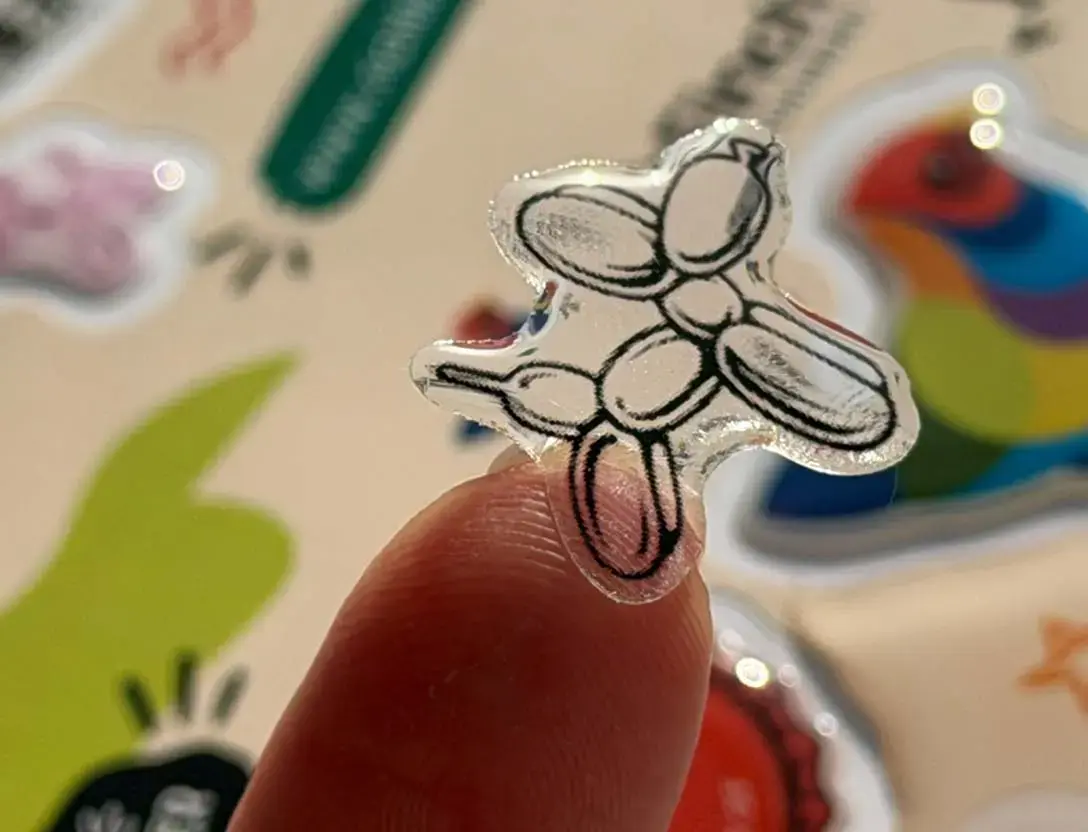
Finch500 uses a European two-component polyurethane resin. It is optically clear, self-levelling and forms a dome that holds its shape at the edge of the die-cut without flowing over it.
The cured polyurethane layer resists yellowing, clouding and discoloration under prolonged sun and weather exposure, and stands up to water, sea water, motor oil, industrial chemicals and scratches. It bonds securely to printed sticker and label surfaces, with no separate primer step, and holds up through repeated humidity and temperature cycling in accelerated ageing testing, without loss of mechanical or visual properties. The coating holds from −30 °C to +60 °C. It is designed for long-term outdoor use and tested for extended UV and weathering exposure.
REACH-compliant · RoHS-compliant · EN71-3 tested
Resin is supplied separately from the machine, matched to it and tested for this process. The minimum order for a production batch is 240 kg – enough material for roughly 150–192 m² of doming coverage, depending on sticker size and resin consumption settings – available through an ongoing supply program, so your production runs on material with known behaviour instead of a new product tested for every order. Dispensing profiles in the software are matched to the supplied resin.
What You Can Produce
Three product families, all cut from printed sheets.
What’s Included
A Finch500 quote covers the equipment and the materials needed to start producing with it.
- Finch500 machineautomatic two-component dispensing, PC-controlled
- Heated curing ovensized for the machine’s sheet format
- 60 curing traysone sheet per tray
- Finch500 software licencelayout preparation and dispensing control
- Operator trainingthe complete workflow, remote guided, on your own layouts
- Remote startupinstallation guidance and first test runs; an on-site visit is possible when a job calls for one
- 1-year warranty
- Resin supply programproduction-grade polyurethane resin, 240 kg minimum order
- Starter set of wear partsthe consumable parts that wear first, supplied with the machine
- Technical supportone point of contact for machine, software and resin
Why 60 Trays Matter
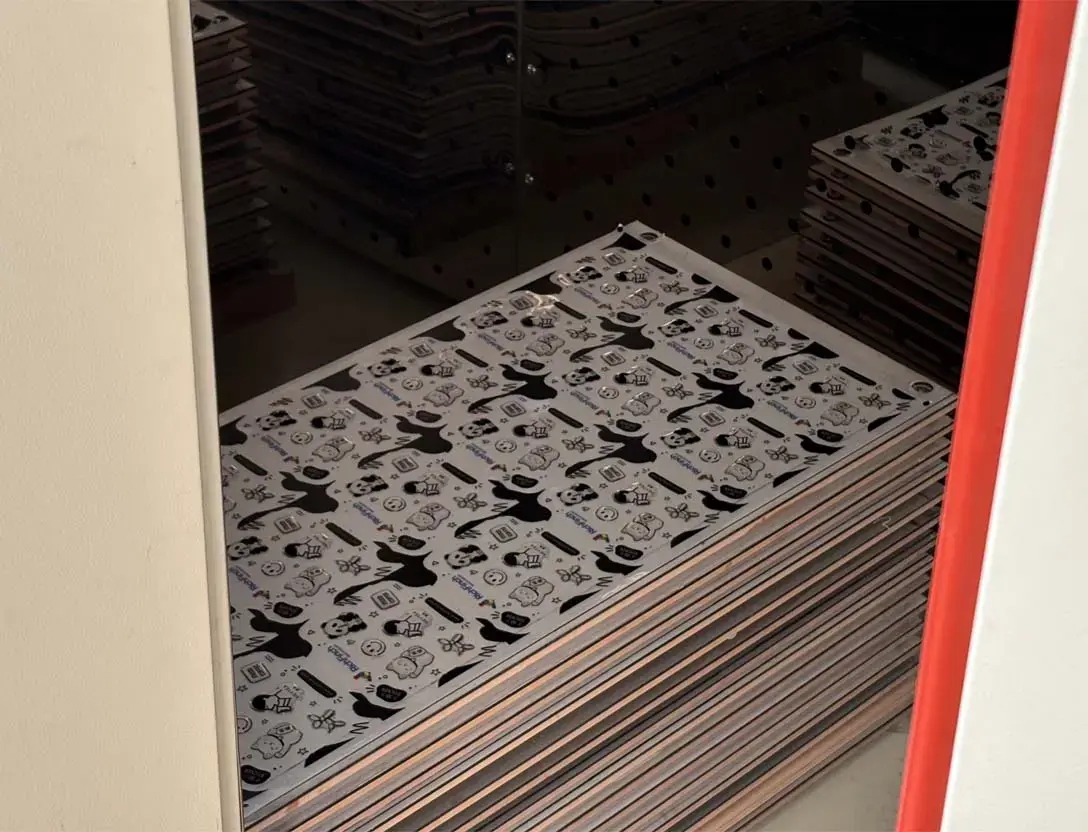
Curing is the slow step in doming. With one batch of trays, the machine waits for the oven. With 60 trays – one sheet each – dispensing continues onto the next trays while the previous batch cures, so the machine runs continuously through most order sizes instead of in stop-start batches. What limits a long run is your shift pattern, the resin on hand and routine maintenance – not the machine waiting for the oven.
A machine price on its own does not include a curing oven, trays, production resin, software configuration, operator training or startup. Those costs do not disappear – they land on you after the machine arrives.
Doming Machine Price
Pricing depends on configuration, destination and delivery terms – request a quote and we’ll respond within one business day.
Machines described as doming equipment range from a few hundred to several thousand dollars, and the numbers are not comparable: they cover different levels of automation, and most of them cover hardware only. A Finch500 quote is the cost of starting a working production line – machine, curing oven, trays, software, operator training, startup and a 1-year warranty in one figure, with delivery terms for your country. Production resin is quoted separately through our ongoing supply program, with a 240 kg minimum order.
Tell us what you plan to produce and in what volumes, and we’ll send pricing with an estimated delivery timeline.
Prefer WhatsApp? Message us directly →Doming Machine FAQ
Do I need to wait for the print to dry before doming?
No. Printed and contour-cut sheets go directly into the machine – there is no drying or degassing stage between printing and resin dispensing.
What materials can be domed?
Printed self-adhesive vinyl sheets. Finch500 is a sheet-based machine: 3D stickers, sticker packs, domed labels and automotive decals are produced from printed sheets, contour-cut before doming.
How is the resin cured?
Dispensed sheets go into the heated curing oven supplied with the machine and are ready for packaging in 3 hours. The package includes 60 trays, one sheet each, so sheets keep going into the machine while previous batches cure.
How much resin does one sticker use?
Consumption depends on sticker size and dome height. Production resin is supplied separately, with a 240 kg minimum order – enough for roughly 150–192 m² of doming coverage – and a consumption estimate for your product mix is included with your quote.
What space and conditions does the machine need?
The installation needs floor space for the machine and the curing oven, an industrial power supply and a ventilated room kept above 20 °C with humidity below 40%. Exact footprint and power requirements are confirmed with the specification for your configuration.
What maintenance does the machine require?
Day-to-day operation is simple: a short routine before each run and the machine’s own wash cycle after it, covered in full during commissioning and operator training. On a longer cycle, the lines, valves and pump calibration are checked every few months, and a set of seals is replaced twice a year. The starter set of wear parts ships with the machine, and the full schedule comes with it.
What warranty do you provide?
Every Finch500 comes with a 1-year warranty covering the machine. Software and resin questions go to the same point of contact as technical support.
What sheet size does the machine take?
Sheets up to 700 × 700 mm. Printing and contour cutting are done on your existing equipment – Finch500 handles resin dispensing.
How long does it take to start producing?
Installation is remote-guided and operator training covers the complete workflow in a couple of days. Delivery time depends on destination.
How much does the Finch500 cost?
Pricing depends on configuration, destination and delivery terms. Request a quote to receive pricing and an estimated delivery timeline for your location.